
The artifact
An instrument for eight bodies.
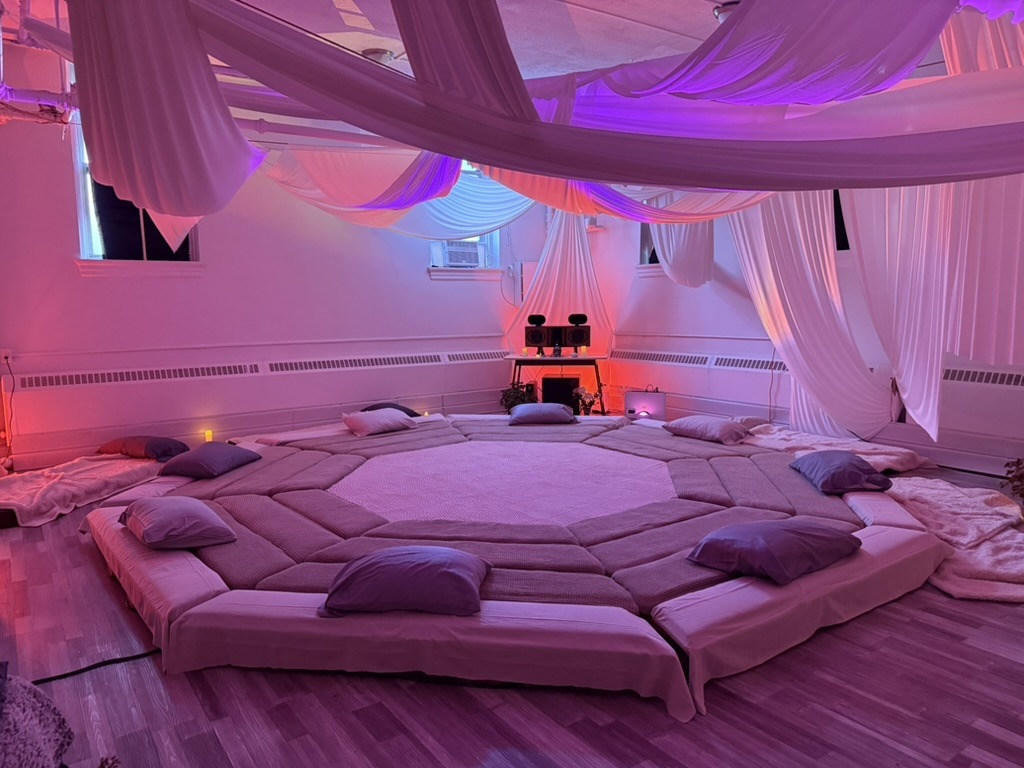
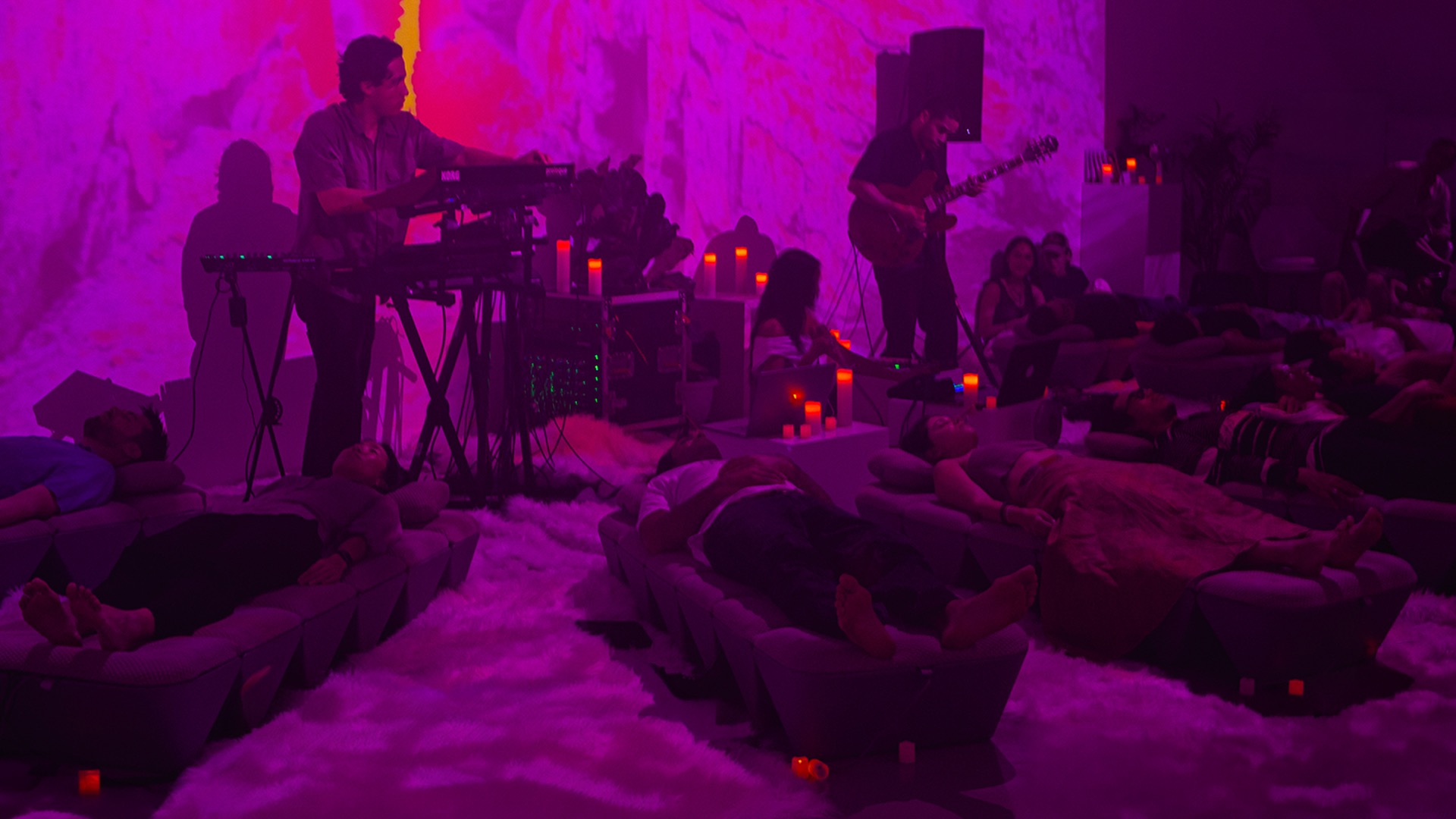
AVA (Audio Visual Artifact) is a participatory sound and light work: a sixteen foot octagon that plays music through the bodies lying on it while generating its light from the same signal. It is an instrument, a room, and a social ritual. This page is for curators, festival art programs, juries and funders.
Music used to be felt before it was heard. Drums, floors, chests, fire. Recorded sound moved it to the ear and then to two small speakers next to the ear. AVA moves it back into the body, and back into a circle.
The work is an octagon of eight wedges. Each wedge is a body-length surface carrying four tactile transducers along its length and sharing a fifth at the centre hub. Five zones, from the feet at 41 Hz up to the head at 880 Hz, are driven as separate voices from the same track, so a song does not just vibrate you: it travels, feet to head, seat to seat. Above and around the bed, a projected field is generated live from the same signal by our own software, so nothing is a video: what you see is what you are feeling.
Eight is the number because it is the smallest circle where strangers become a group. Guests choose the music. The work has no single author of its content; it is an instrument that anyone can play by pressing play, and the room decides what to do with it.
We build it ourselves in Brooklyn: wood frame, cushion, transducers, amplifiers, an audio interface, a computer, a projector, and two pieces of software we wrote and released: AVA OS, which turns any system audio into five channels of body vibration, and Easel, the visual engine that draws the light field from the audio in real time. Both are open on GitHub. The artifact is meant to be reproduced.
50 words
AVA is a shared haptic listening room: a sixteen foot octagon where eight people lie down and any song becomes full body vibration across five zones, from 41 Hz at the feet to 880 Hz at the head, while generative light is drawn live from the same signal. Built and coded in Brooklyn.
150 words
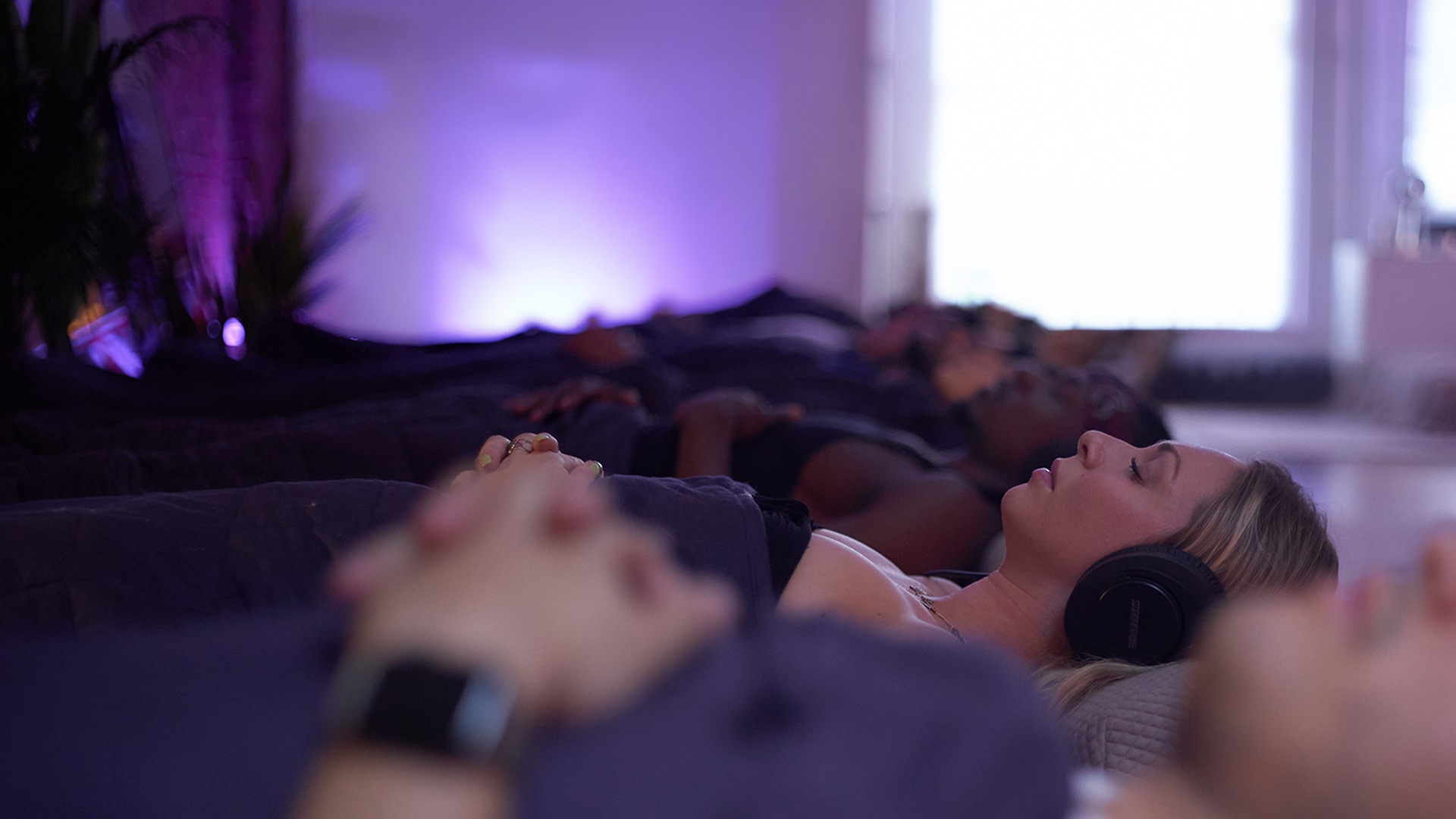
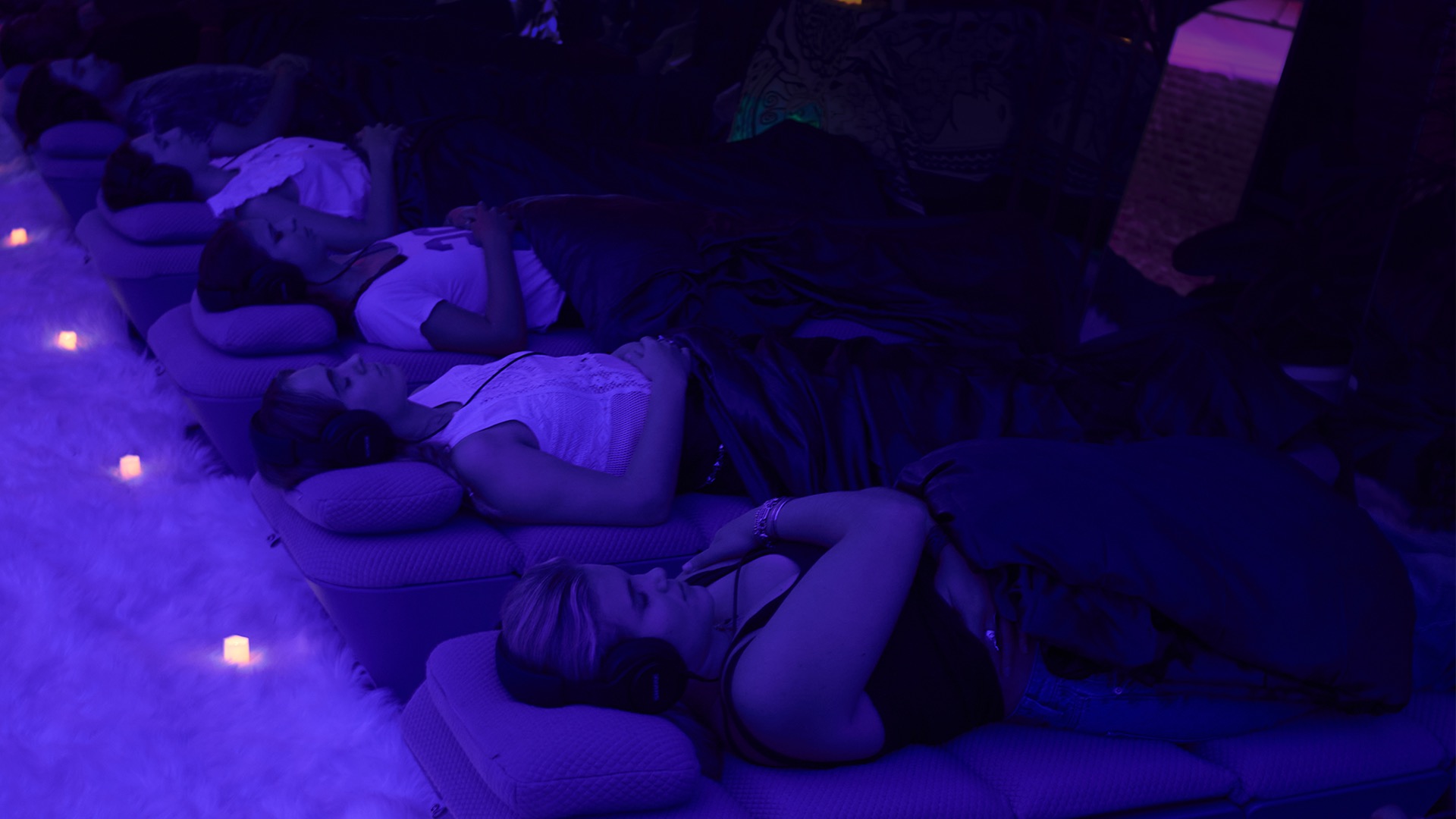
AVA (Audio Visual Artifact) is a participatory installation and instrument by Audio Visual Artifacts, a Brooklyn studio. A sixteen foot octagon of eight body-length wedges carries thirty-three tactile transducers, driven as five zones from feet (41 Hz) to head (880 Hz). Any music, chosen by the guests, is separated and time-aligned so it travels through the body and around the circle, while a projected light field is generated from the same audio in real time by the studio's own open-source software. Sessions last 45 to 90 minutes and hold eight people at once, which is the point: the work is designed to be felt together, in a dark room, with strangers. AVA runs weekly as a public room at 29 Nassau Ave in Greenpoint and travels as a portable installation to festivals, museums and events. Guests describe it as relaxing, emotional, and unlike anything else. The studio reads the research on vibroacoustic stimulation honestly and makes no medical claims.
Keywords
Haptic music, vibroacoustic, participatory installation, generative visuals, social wellness, new instrument, open source hardware and software, Brooklyn.
- Dimensions
- Octagon 16 ft flat to flat (4.9 m), bed height about 18 in (46 cm) on an under-frame. Scales down to 8 ft and to a single wedge for tight spaces. Weight per wedge about 90 lb (41 kg).
- Space
- Minimum 20 by 20 ft (6 by 6 m). Ideal 25 by 25 ft with 10 ft (3 m) ceilings, blackout, and a floor that takes 900 lb distributed.
- Power
- Under 900 W for the bed on one 15 A / 120 V circuit (or 10 A / 230 V). Projection and lighting on a second circuit.
- Audio
- 33 tactile transducers (25 W RMS, 4 ohm), two amplifiers, one 8-channel USB audio interface, a computer running AVA OS (macOS 14.4 or later, Apple silicon). Optional feed from FOH for live performance.
- Visual
- One 4K projector (5,000 lumens or brighter for large rooms) or an LED wall, driven by Easel over NDI or HDMI. Ceiling, wall or dome projection all supported.
- Crew
- Two people for install (3 hours) and strike (90 minutes). One host per open hour. We train local hosts for longer runs.
- Duration
- Drop-in format 10 to 15 minutes per group of eight; programmed sessions 45 to 90 minutes.
- Access
- Step-free access to the bed. Guests transfer from a wheelchair with assistance. Visuals are slow and low-contrast by design; no strobing. Contraindications posted and briefed.
- Freight
- Fits one cargo van. Crates available for air freight. International power supported.
2024 to 2025: research, prototypes and the first public sessions in Brooklyn under the studio's earlier name. 2026: the studio becomes Audio Visual Artifacts; AVA is the first artifact. The public room opens at 29 Nassau Ave, Greenpoint, with weekday wellness sessions and evening programs, and a first season of live sets, album nights and a fashion night. AVA OS 1.1 and the Easel engine are released as open source.
The lineage runs from Olav Skille's vibroacoustic beds in 1980s Norway and Tony Wigram's clinical work, through Lee Bartel's 40 Hz research in Toronto, to the current wave of solo sound beds. AVA differs in three ways: it is shared, it is music-first (any song, not a fixed tone), and it is audiovisual, with light generated from the same signal. Read more on the science page and in the Sound Journal.
Everything a jury or curator usually asks for, in one place.
- Statement and descriptions
- On this page, 50 and 150 words, plus a longer statement on request.
- Images
- Twelve stills at 4K and two videos (a 90 second overview, a 20 second loop) in the press kit.
- Technical rider
- Above. PDF on request.
- Budget template
- Install, crew, travel, per diem, insurance, freight. We share a filled example for a 3 day festival run on request.
- Bios
- Studio bio and founder bio in the press kit.
- Documentation of past runs
- Weekly public sessions in Brooklyn since 2025; festival and museum runs announced on the calendar. References from partners on request.
- Safety and accessibility statement
- Posted contraindications, software-limited output, step-free access, no strobing, staffed at all times.
- Fiscal sponsorship
- Available through a New York fiscal sponsor for grants that require a nonprofit applicant. Ask.
Curators and program directors: team@avartifacts.com. Or use the road inquiry form.